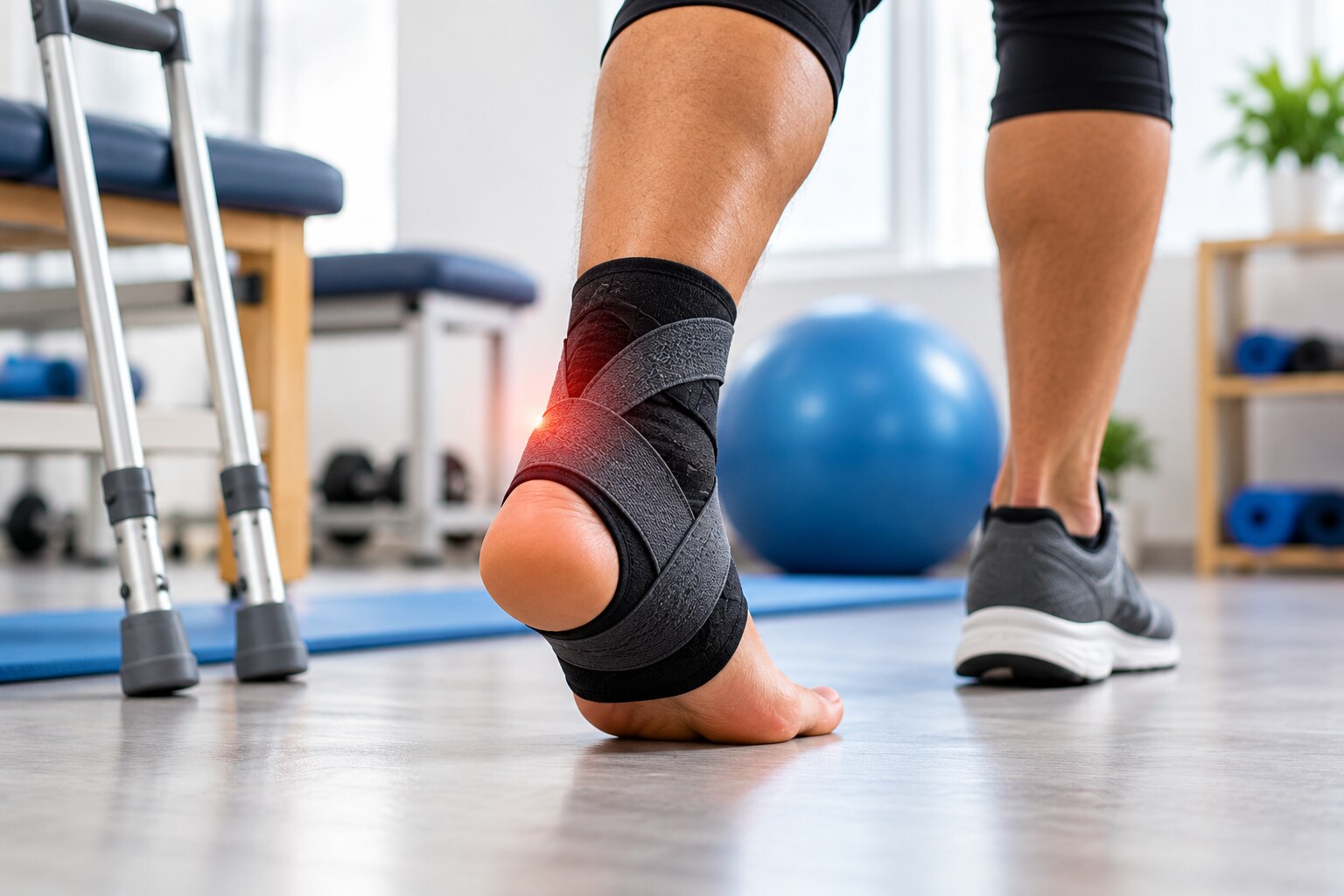
A continuing limp, difficulty bearing weight, or repeated ankle giving-way deserves more than indefinite rest. You will learn how to separate a normal recovery slowdown from a warning sign, understand which walking milestones matter, and see how rehabilitation progresses safely after a sprain, fracture, immobilisation, or surgery.
Key takeaways
- Seek reassessment if you cannot take four steps.
- A next-day increase in pain, swelling, or limping signals excessive load.
- Identify whether pain, stiffness, weakness, balance, or swelling limits walking.
- Return to an orthopaedic clinician when progress stalls or symptoms worsen.
When walking difficulty needs reassessment, not more rest
If you cannot take four steps, or walking is clearly worse than yesterday, arrange medical reassessment instead of adding more rest. Routine soreness after ankle sprain recovery physiotherapy should settle within hours; a next-day increase in limping, swelling, or pain means the load, range, or exercise volume is too high.
Seek urgent review for:
- An obvious deformity, sudden displacement, focal tenderness over the ankle bones, base of the fifth metatarsal, or navicular, or pain that prevents weight-bearing; these findings can indicate an unrecognised fracture and support repeat ankle or foot radiographs under the Ottawa Ankle Rules.
- Locking, persistent night pain, numbness, or pain above the ankle with push-off; these signs need assessment for cartilage, nerve, tendon, or syndesmotic injury.
- Calf pain or swelling, especially with breathlessness or chest pain; seek emergency care for possible deep-vein thrombosis.
- A foot that becomes cold, pale, blue, or unusually warm, red, and increasingly swollen. This requires urgent assessment for circulation problems, infection, or displacement, particularly after surgery, a wound, or immobilisation.
The Ottawa Ankle Rules support imaging when you have bone tenderness at either malleolus, the base of the fifth metatarsal, or the navicular, or cannot bear weight both immediately after injury and during examination. Persistent walking limitation that fails to improve along its expected path also warrants review, even when the first X-ray was normal.
Walking milestones after a sprain, fracture, or operation
Pain reduction is only one milestone; walking recovery also requires safe loading, less support, a controlled gait, and restored balance.
| Injury | Usual early progression | Later milestone |
|---|---|---|
| Mild lateral sprain | Protected weight-bearing with a brace or tape; crutches reduce as walking becomes steady | No limp, controlled stairs, single-leg standing, then uneven ground |
| Severe ligament injury | Short immobilisation, sometimes up to 10 days, followed by staged loading | Strength and balance return before running or jumping |
| High-ankle sprain | Slower loading when pain sits above the ankle or push-off hurts | Walk normally and tolerate rotation before progressing speed |
| Ankle fracture | Boot, cast, or crutches at the surgeon’s written weight-bearing level | Progress only after radiographic healing and clearance |
| Immobilisation | Restore ankle movement and calf activation gradually after protection ends | Stairs, single-leg control, and uneven surfaces follow basic walking |
| Surgery | Follow the operation-specific boot and weight-bearing protocol | Advance strength and gait only when the surgeon permits it |
Use this checklist to judge progress:
- Tolerate the permitted weight-bearing level without a next-day increase in swelling or limp.
- Reduce crutch or walker use only when you can maintain an even step and upright posture.
- Walk without a limp before testing long distances, slopes, or uneven ground.
- Climb and descend stairs with controlled foot placement, not by pulling yourself up.
- Stand on the injured leg before adding uneven surfaces or faster walking.
After an ankle fracture, less pain does not authorise a jump from non-weight-bearing to full weight-bearing. Ankle fracture movement rehabilitation in Kharadi, or elsewhere, must follow imaging and the surgeon’s written instructions; a stable sprain follows a different pathway.
What is actually limiting your walking?
A settled ligament injury does not guarantee normal walking: pain, weakness, stiffness, poor balance, or fear of loading can each remain the main limiter.
| Problem | What to check | What helps |
|---|---|---|
| Pain-limited | Irritability, swelling, tenderness, and response to tissue loading | Reduce provoking load and rebuild it gradually |
| Weakness-limited | Calf raise capacity, peroneal strength, and whole-leg control | Progressive calf, peroneal, hip, and leg strengthening |
| Stiffness-limited | Measured dorsiflexion and plantarflexion | Repeated range-of-motion work within the medical restrictions |
| Balance-limited | Single-leg stance, proprioception, and foot and hip control | Single-leg and balance drills |
| Fear-limited | Guarding despite acceptable pain and healing | Graded exposure, not forced walking speed |
The assessment should compare your gait, step length, stance time, heel-to-toe progression, push-off, inversion and eversion, swelling, tenderness, footwear, and exact weight-bearing instructions. A normal-looking X-ray does not prove that your calf strength, ankle motion, or walking symmetry has returned.
Alam's Physio Care can use these findings to select loading and gait exercises instead of treating every walking problem with massage or machines. This matters when searching for ankle injury physiotherapy for walking problems in Kharadi: the treatment must match the limiting factor.
Mild soreness that settles quickly can follow exercise. Reduce range, load, or volume if swelling, night pain, a worse limp, or next-day walking function increases.
Related service
Ankle Sprain, Ankle Fracture Rehabilitation,Tendonopathies & Soft Tissue Injuries,Ankle Impingement Syndromes Physiotherapy for ankle injury 🦶 Ankle Physiotherapy & Rehabilitation Ankle rehabilitation is a specialized physiotherapy program designed to restore strength, stability, and... View service → |
How rehabilitation rebuilds safe, efficient walking
Once serious injury has been excluded and weight-bearing instructions are clear, rehabilitation should rebuild walking in stages rather than rely on rest alone. For a routine sprain, early protected weight-bearing with a brace or taping helps maintain movement while reducing strain.
A severe sprain may need immobilisation for up to about 10 days; longer immobilisation can prolong stiffness, weakness, and poor walking.
- Control swelling with elevation, compression when appropriate, and the prescribed support.
- Restore comfortable dorsiflexion and plantarflexion. Do not force a stiff ankle into sharp pain.
- Strengthen the calf, peroneal muscles, and other ankle and leg muscles with gradually increasing resistance.
- Train balance and proprioception, progressing from supported standing to single-leg control.
- Retrain gait by improving step length, stance time, heel-to-toe progression, and push-off.
- Practise stairs with controlled loading before increasing speed.
- Add faster walking, uneven ground, hopping, and work- or sport-specific tasks only after basic walking is steady.
Mild soreness that settles quickly can be acceptable during ankle sprain recovery physiotherapy. Sharp pain, increased swelling, night pain, a worse limp, or poorer next-day function means reducing the exercise range, load, or volume. Effective ankle sprain recovery physiotherapy progresses loading without turning a manageable response into a setback.
When to change the plan or return to an orthopaedic clinician
A stalled recovery is a reason to change the plan, not simply add harder exercises. Pain above the ankle, painful push-off, repeated giving-way, locking, or persistent asymmetry can signal a syndesmotic injury, chronic ankle instability, osteochondral lesion, tendon injury, substantial ligament damage, or a missed fracture.
1. Arrange an orthopaedic review when walking is not steadily improving, especially if you still limp, cannot load the ankle, or lose control on one leg. Ask whether repeat radiographs, ultrasound, or MRI is appropriate; the best test depends on suspected bone, cartilage, tendon, or ligament damage.
2. Seek urgent assessment for worsening swelling, night pain, numbness, calf pain, fever, deformity, or a foot that becomes cold, pale, blue, or unusually warm. Do not increase exercise intensity until displacement, infection, thrombosis, or an unrecognised fracture has been excluded.
3. Keep using crutches or a brace until your prescribed weight-bearing level is comfortable; abandoning support early can reinforce a limp. Avoid complete rest for weeks, forcing a stretch through sharp pain, or testing recovery with a long walk.
4. Return to sport only after normal walking, controlled stairs, single-leg balance, and progressive load tolerance are restored. Mild soreness that settles quickly is acceptable; increased swelling, night pain, or worse next-day walking means reduce range, load, or volume.
If you searched ankle rehabilitation for walking difficulty kharadi, choose assessment-led care rather than a generic exercise sheet. Fracture rehabilitation follows healing and clearance, while ankle sprain recovery physiotherapy follows protected loading and stability testing.
Frequently asked questions
When does ankle walking difficulty need reassessment?
Arrange reassessment if you cannot take four steps or walking is worse than the previous day. Increasing next-day pain, swelling, or limping also needs review.
What can limit walking after an ankle injury?
Pain, swelling, restricted ankle movement, weakness, poor balance, reduced confidence, and an inefficient walking pattern can each limit walking.
How does rehabilitation improve walking after an ankle injury?
Rehabilitation progressively restores ankle movement, strength, balance, weight-bearing tolerance, and walking control without provoking a next-day flare.
When should you return to an orthopaedic clinician?
Return when walking worsens, progress stalls, weight-bearing remains severely limited, or symptoms suggest the original injury needs further assessment.
Keywords